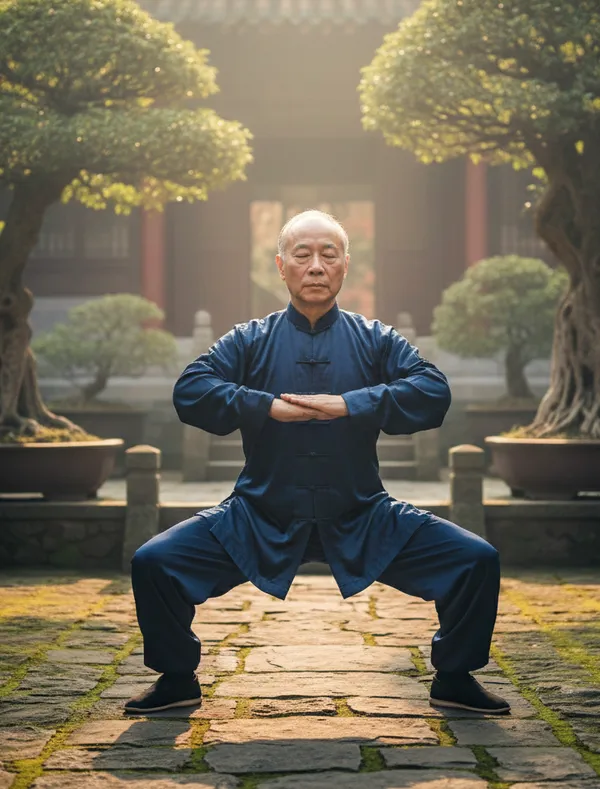
The Horse Stance (Ma Bu): The Ancient Posture Validated by Modern Sports Science
-
January 22, 2026 -
Ferenc Németh
Anyone who has ever participated in a serious Qigong or martial arts session has encountered Ma Bu, also known as the Horse Stance. It’s the pose that makes a beginner's legs tremble and an advanced practitioner's forehead break into a sweat. Many see it as a "necessary evil" or purely as a way to develop willpower.
However, the old masters didn't call this stance the cornerstone of practice by accident. Research published in the Journal of Strength and Conditioning Research and modern sports science now accurately understand what happens in the body during this practice. It turns out: the Horse Stance is one of the most powerful metabolic-boosting exercises that exists.
Let's look at why it's worth holding the pose even when your muscles are burning!
1. The Silent Powerhouse: Maximum Isometric Tension
The secret of Ma Bu lies in its static nature. When you take the position, you place the body's largest muscle groups—the quadriceps, glutes, and adductors—under continuous mechanical tension.
- We do all this without joint impact. Unlike running or jumping, there is no impact to wear down the knees, yet the musculature performs massive work.
2. Hormonal Response: The Fountain of Youth (Growth Hormone)
The most exciting part of the scientific explanation is what happens in the bloodstream. Since the legs hold the body weight under continuous tension (without rest), a temporary blood flow restriction (occlusion) occurs in the muscles. This causes metabolic stress and lactic acid (lactate) accumulation.
Don't be intimidated by the word "stress"—in this case, it's positive! Research conducted by Goto et al. proved that this type of continuous load triggers a drastic growth hormone (GH) response from the body.
Growth hormone is one of our body's most important "internal medicines":
- It aids in the regeneration of tissues (muscles, tendons, skin).
- It supports fat burning.
- It slows down the aging processes.
In Qigong terms: this is one of the purest physical forms of nourishing Jing (life force). When you feel the "burning" sensation in your thighs, know that you are giving your body a rejuvenating hormonal boost.
3. The Lower Dan Tian and Circulation
Research specifically highlights the role of the adductor muscles and the pelvic floor, which perform active work during Ma Bu. This significantly improves circulation in the urogenital area.
As practitioners, we know that this area is the home of the Lower Dan Tian. Physical strengthening, therefore, also brings energetic stability, helping with "grounding" and energy retention.
The Good News for My Students: You’re Already Doing It!
If you regularly come to practice with me, I have great news: you are well exceeding the amount recommended by science.
Our Qigong exercises are full of hidden or explicit horse stances and deep, static holds. During an average class—while we focus on flow and breathing—your legs are working unnoticed. You don't just complete the recommended 2 minutes a day; by the end of the session, you often approach 10 minutes of pure muscle work time. Thus, not only do you quiet your mind, but every single session provides a serious cell-regenerating treatment for your body.
Daily Protocol (For Home Practice)
If you want to incorporate it into your routine outside of classes:
- Position: Wide stance, hips lowered as if sitting on an invisible chair. Back straight.
- Important: Knees should point outward, never collapse inward!
- Time: 2 minutes total daily (for beginners: 4 x 30 sec).
References and Scientific Background
The research supporting these claims ("The Impact of Metabolic Stress on Hormonal Responses...") was published in the Journal of Strength and Conditioning Research.
Click here to read the research abstract (PubMed)
And what about the Soul?
Science is fascinating, but in Shaolin Qigong, there is a deeper layer beyond the physical effect. How does the deep stance build willpower and spiritual roots?
Read my other article: "Beyond Pain - The Secret of Deep Stances"